20 Minimalist Living Room Ideas That Create a Beautiful and Timeless Space
Walk into the wrong room and you feel it immediately. Too much of everything, competing in every direction for the same moment of attention. Now walk into the right room and you feel that too, only the sensation is completely different. The body relaxes. The mind settles. Something in the space gives you permission to simply be there without processing a hundred different visual signals at once.
That second room is almost always built on the principles of minimalist living room design. Not on emptiness, not on the absence of personality, but on the disciplined idea that a room with fewer, better chosen elements is always more beautiful than a room that tries to hold everything at once. The homes that consistently photograph best, feel best, and age best are the ones that understood this long before it became a trend.
Warm minimalism, the current and most resolved version of this philosophy, layers natural materials, earthy neutral tones, tactile textiles, and genuine craft into rooms that feel calm and considered without ever tipping into the sterile quality that once gave minimalism a reputation for being cold. This guide covers 20 ideas that show exactly how that balance works in a living room, from the palette on the walls to the object on the coffee table.
A Warm Earthy Neutral Palette as the Foundation
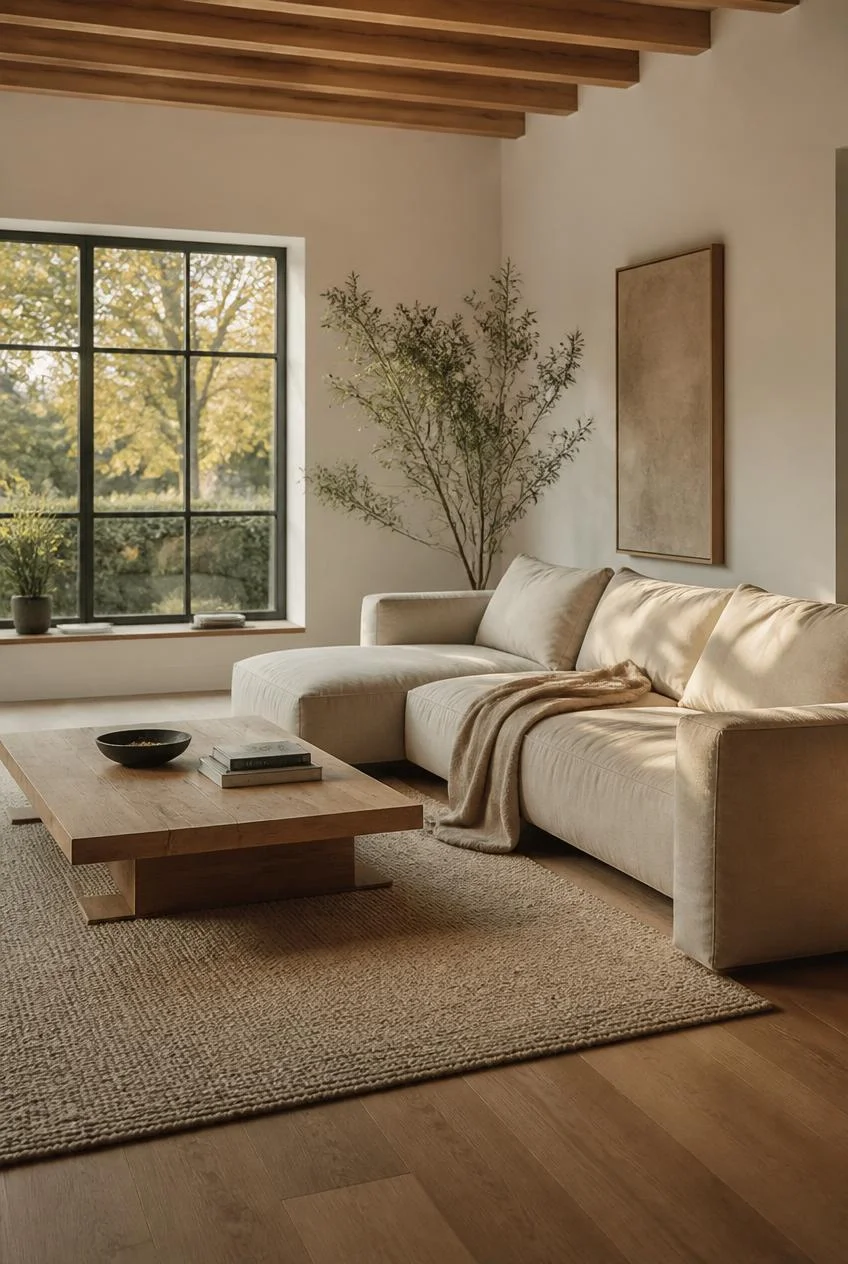
The palette of a minimalist living room determines everything that follows, which is why getting it right is the single most important decision in the process. The current direction in minimalist interior design moves away from cold stark white and toward warm earthy neutrals, including sandy beige, soft caramel, warm ivory, and muted clay. These tones share a quality that pure white lacks: they read as warm under both natural daylight and artificial evening light, which means the room looks as good at seven in the morning as it does at nine at night.
Building the palette from three closely related tones rather than a single flat color gives the room depth without visual complexity. A warm white wall, a sandy beige sofa, and a natural oak floor or rug in an undyed wool tone work together as a layered neutral foundation that accepts additional natural materials easily and creates a room that ages beautifully rather than feeling dated within a few years.
Why Earthy Over White
White walls are often chosen by default rather than intention, and they do not always suit a warm minimalist living room as well as a slightly warmer equivalent. A wall tone with a cream or clay undertone keeps the room feeling residential and alive rather than clinical, particularly in rooms that receive limited natural daylight.
A Low-Profile Sofa With Clean Horizontal Lines
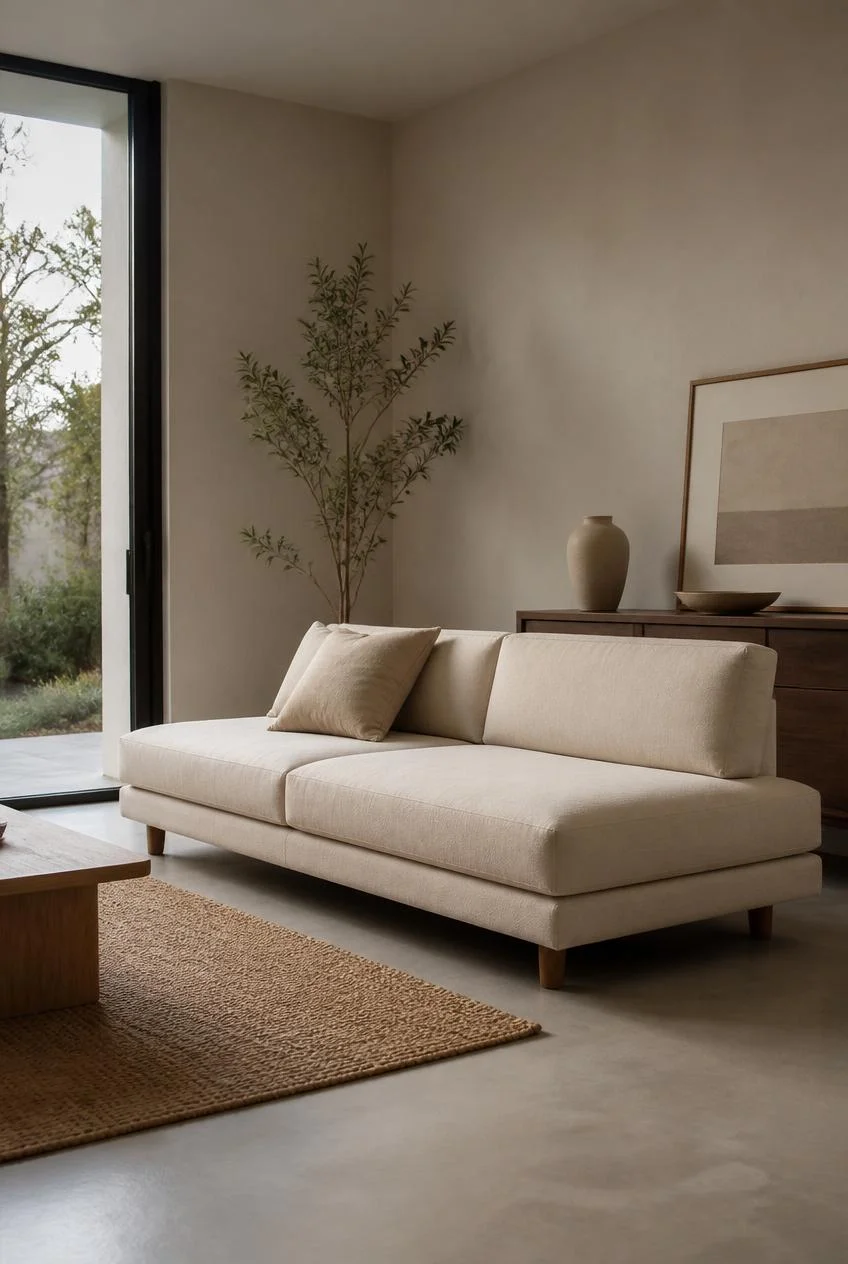
The sofa is the largest object in most living rooms, which makes it the single most consequential design decision in the space. A low-profile sofa with clean horizontal lines, sitting closer to the floor than a standard seat height, gives the room a sense of calm and visual openness that a higher, bulkier sofa cannot replicate. The lower silhouette also makes the ceiling feel taller by comparison, which is a particular advantage in apartments or rooms with limited vertical space.
Linen or bouclé upholstery in a warm neutral tone such as cream, oatmeal, or warm grey suits the minimalist aesthetic naturally, since both materials have a slightly irregular surface texture that gives them visual warmth while remaining entirely within the neutral palette. Avoid sofas with overly ornate piping, tufting, or visible decorative stitching, since these details introduce additional visual complexity that works against the clean lines the format requires.
Seat Depth and Comfort
Low profile does not mean uncomfortable. A sofa with a deeper seat depth, around 24 to 26 inches, combined with a low back height delivers the same restful, relaxed posture as a more standard height design while maintaining the visual openness that defines a minimalist living room.
Wood Slat Wall Panels for Warmth and Texture
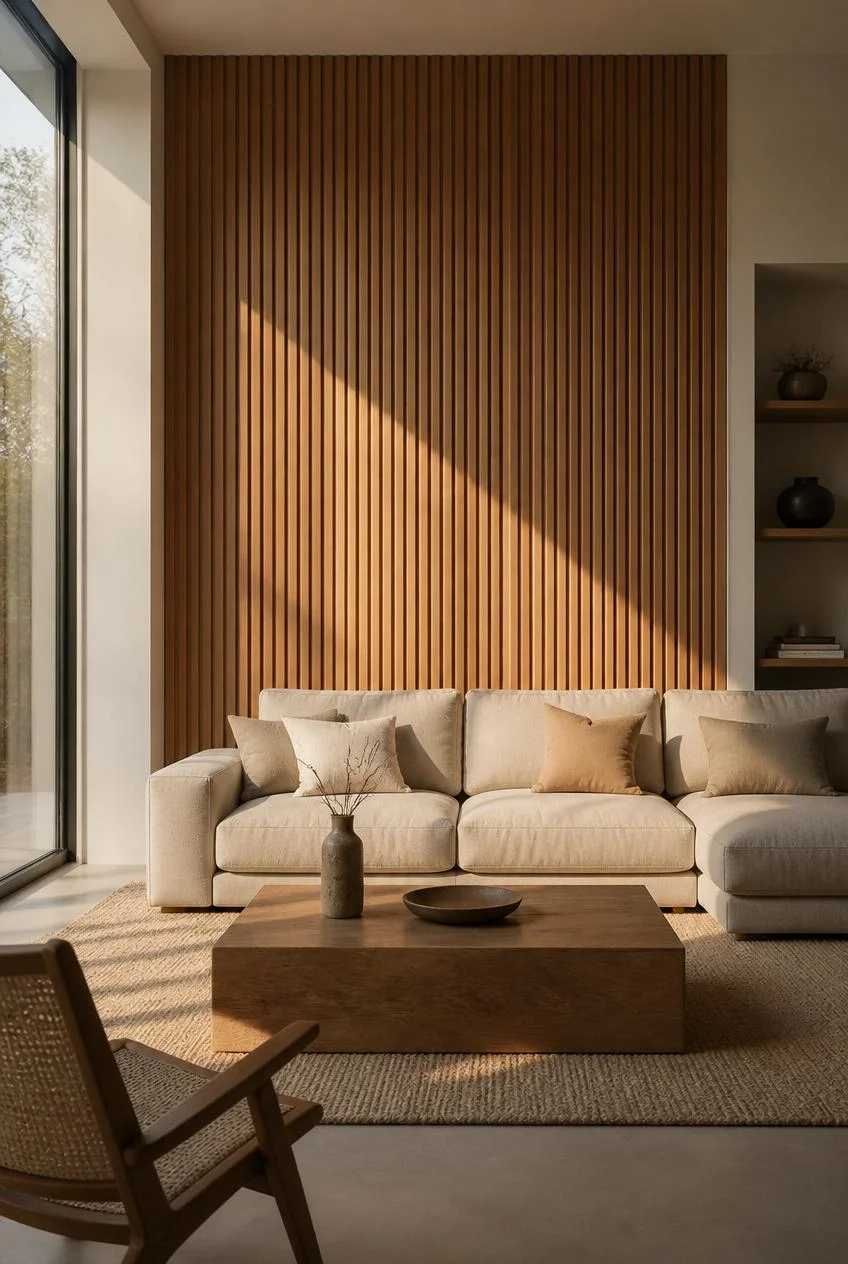
A wood slat wall panel, whether running floor to ceiling or positioned as a single accent feature behind the sofa or television, introduces warmth and architectural texture into a minimalist living room without requiring paint, art, or additional decorative objects to make the wall feel resolved. The vertical rhythm of the slats creates visual interest through repetition and depth, since the shadows between each slat change throughout the day as natural light shifts.
Light oak or warm walnut slats in a simple profile suit most warm neutral palettes without competing with the surrounding room. A slat panel installed on the wall behind the sofa gives the seating area a distinct sense of enclosure and definition within an open plan living space, functioning similarly to a feature wall without the commitment of a single bold paint color.
Installation Consideration
Freestanding or panel-mounted wood slat systems are increasingly available as prefabricated solutions that install without specialist carpentry, making this idea accessible well beyond renovation-scale projects. Many versions are also suitable for rented properties.
Curved Furniture That Softens the Room’s Geometry
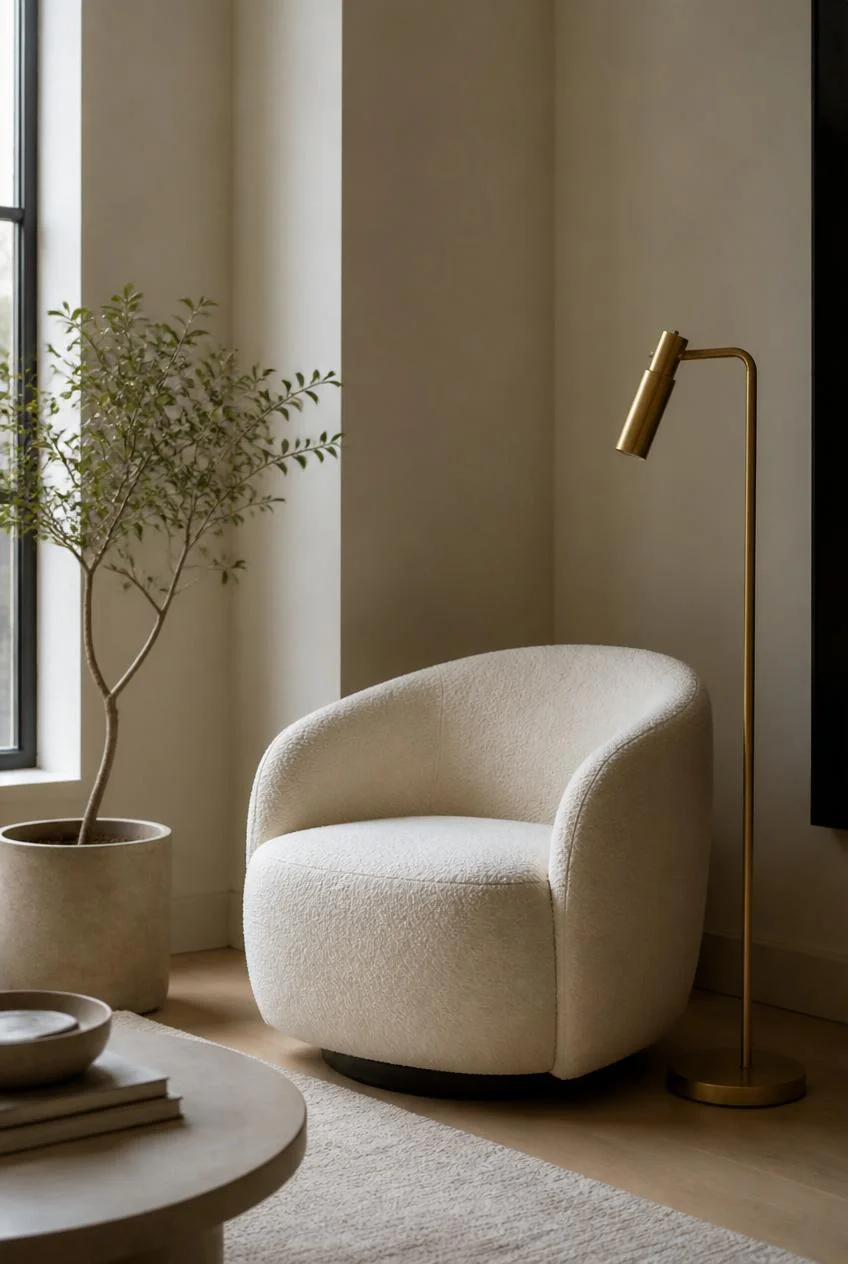
In a room built on straight lines and right angles, a single curved furniture piece introduces an organic quality that immediately changes how the room feels to be in. A curved armchair, a rounded sofa section, or a circular coffee table in the context of an otherwise rectilinear space creates a visual tension that reads as intentional and sophisticated rather than accidental.
The current direction in Japandi interior design and Scandinavian minimalism leans heavily toward these organic forms, treating curved furniture as a way of softening the discipline of minimalism rather than decorating around it. A bouclé curved armchair positioned beside a floor lamp in a living room corner creates a reading spot with genuine warmth and visual character using just two objects.
Why Curves Work in Minimalism
Straight lines dominate most furniture and architecture. When a curved form appears in a space built on those straight lines, the contrast draws the eye immediately, which is exactly how a single curved piece can function as a focal point without requiring anything decorative around it.
A Single Statement Art Piece on One Bare Wall
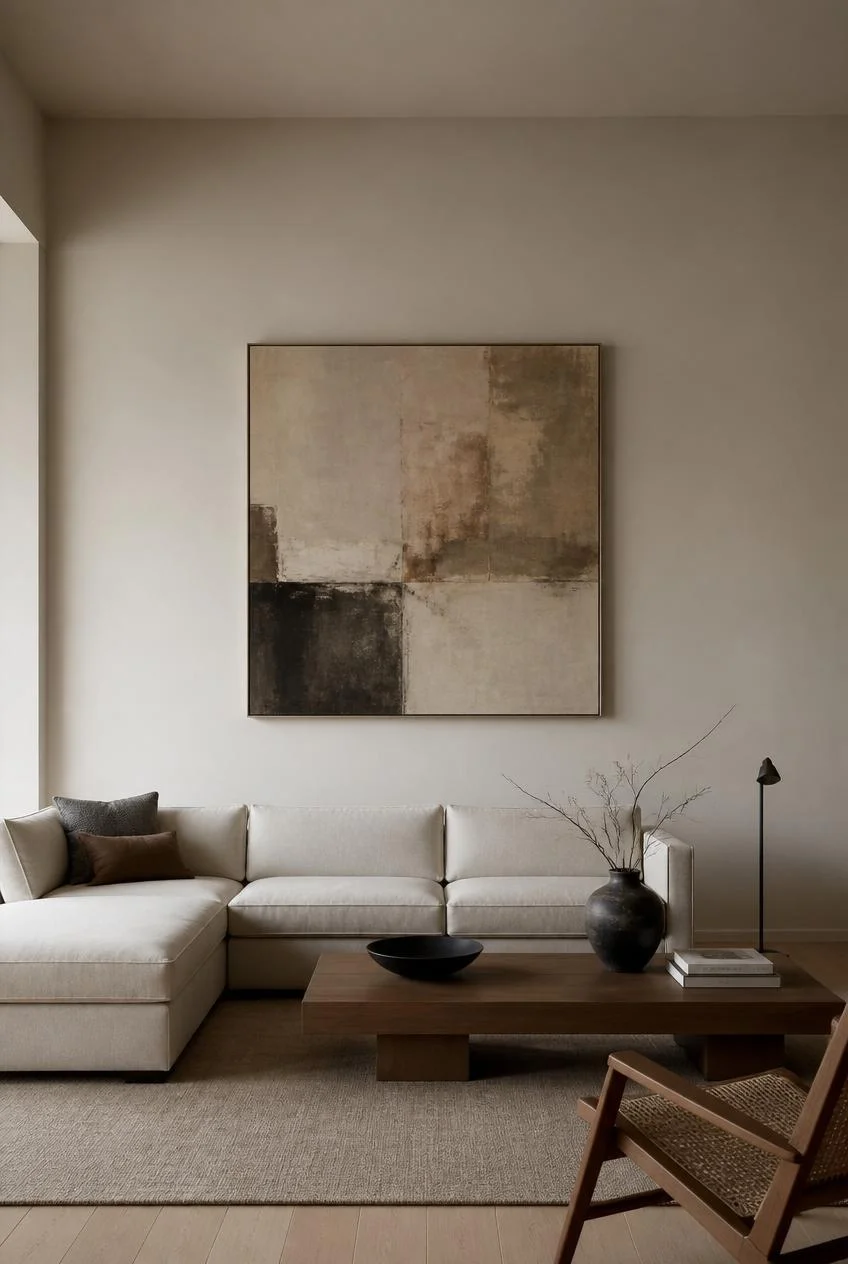
The minimalist approach to wall art is not to avoid it but to commit to it more fully than most people are comfortable doing. A single large-scale artwork, sized to occupy roughly two thirds of the available wall width, on a bare wall with generous breathing room on all sides carries exponentially more presence than the same piece surrounded by five others.
The empty wall around a statement artwork is not wasted space. It is what gives the piece its full visual weight. In a minimalist living room, this principle applies to every wall in the room. Choose one surface for art and leave the others clear, positioning the single piece where it will be seen clearly from the main seating position rather than only noticed when walking past it.
Art Selection
Abstract art in muted earthy tones or a large scale black and white photograph sits most naturally within a warm minimalist palette. Avoid highly detailed figurative work or pieces with multiple competing colors unless the surrounding room is neutral enough to absorb that complexity without disruption.
A Natural Fiber Rug That Defines the Seating Zone
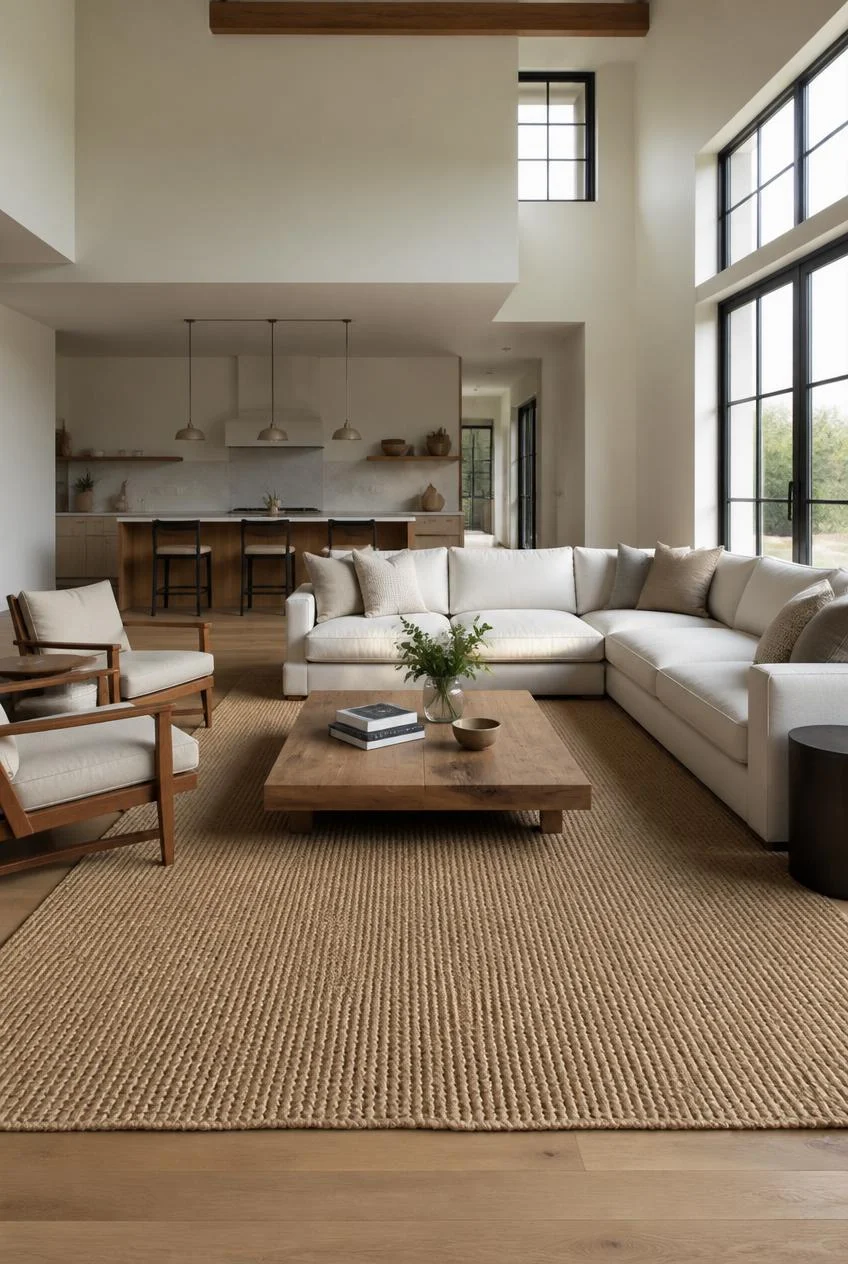
In an open plan living space, a natural fiber rug is one of the most effective tools for defining the seating area without walls or partitions. A jute, sisal, or undyed wool rug extended generously beneath and beyond the sofa and chairs on all sides creates a zone that feels distinct and intentional within the larger floor plan while introducing texture and organic warmth at floor level.
The rug should be large enough that the front legs of all seating furniture rest on it, since a rug that stops short of the furniture creates a disconnected arrangement that makes the room feel smaller rather than more defined. In a minimalist living room, the rug tone should sit close to the floor color rather than contrasting sharply with it, so the transition between rug and floor reads as a gradual material shift rather than a bold boundary line.
Texture Over Pattern
A flat weave or low pile rug in a natural undyed tone suits the minimalist aesthetic more consistently than a heavily patterned alternative, since the texture comes from the weave of the material itself rather than from a printed or woven design that competes with the room’s overall restraint.
A Slim Sideboard for Concealed Storage
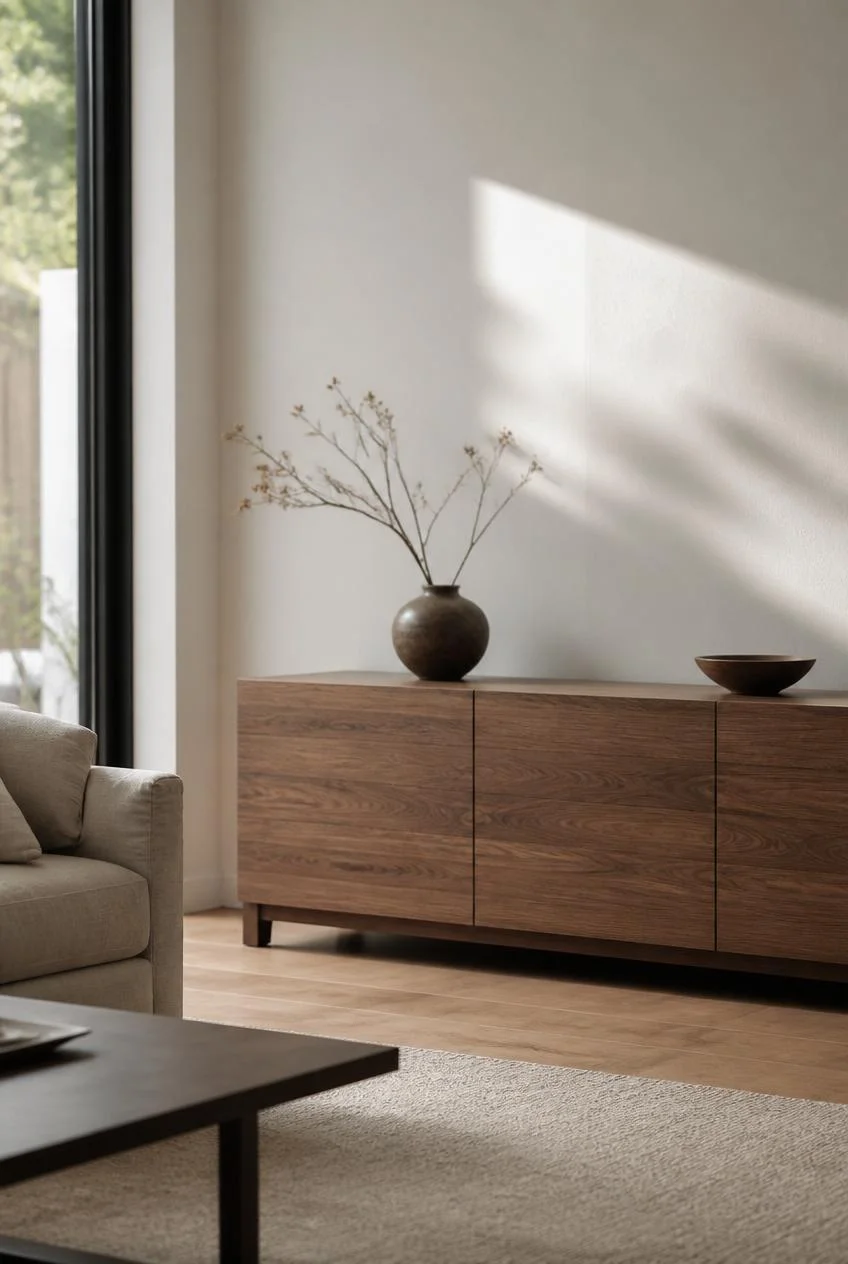
The discipline of a minimalist living room depends on having somewhere to put everything that does not belong on display. A slim sideboard or low credenza with closed doors, positioned along one wall, provides the hidden storage capacity that keeps the rest of the room free of the small objects, remote controls, charging cables, and paperwork that accumulate in any genuinely lived in home.
A sideboard in a warm wood tone or matte painted finish with no visible hardware, using flush fronts or push-to-open mechanisms, reads as a single horizontal architectural element rather than a piece of furniture assembled from visible components. The surface on top should hold no more than two or three objects at any one time, since the sideboard top is one of the surfaces most likely to become an unconscious accumulation point.
Proportional Note
A sideboard that sits at approximately the same height as the window sill, typically around 28 to 32 inches, creates a pleasing horizontal alignment with the lower portion of the window that reinforces the clean lines of the minimalist room.
Visible Floor Space as a Deliberate Design Choice
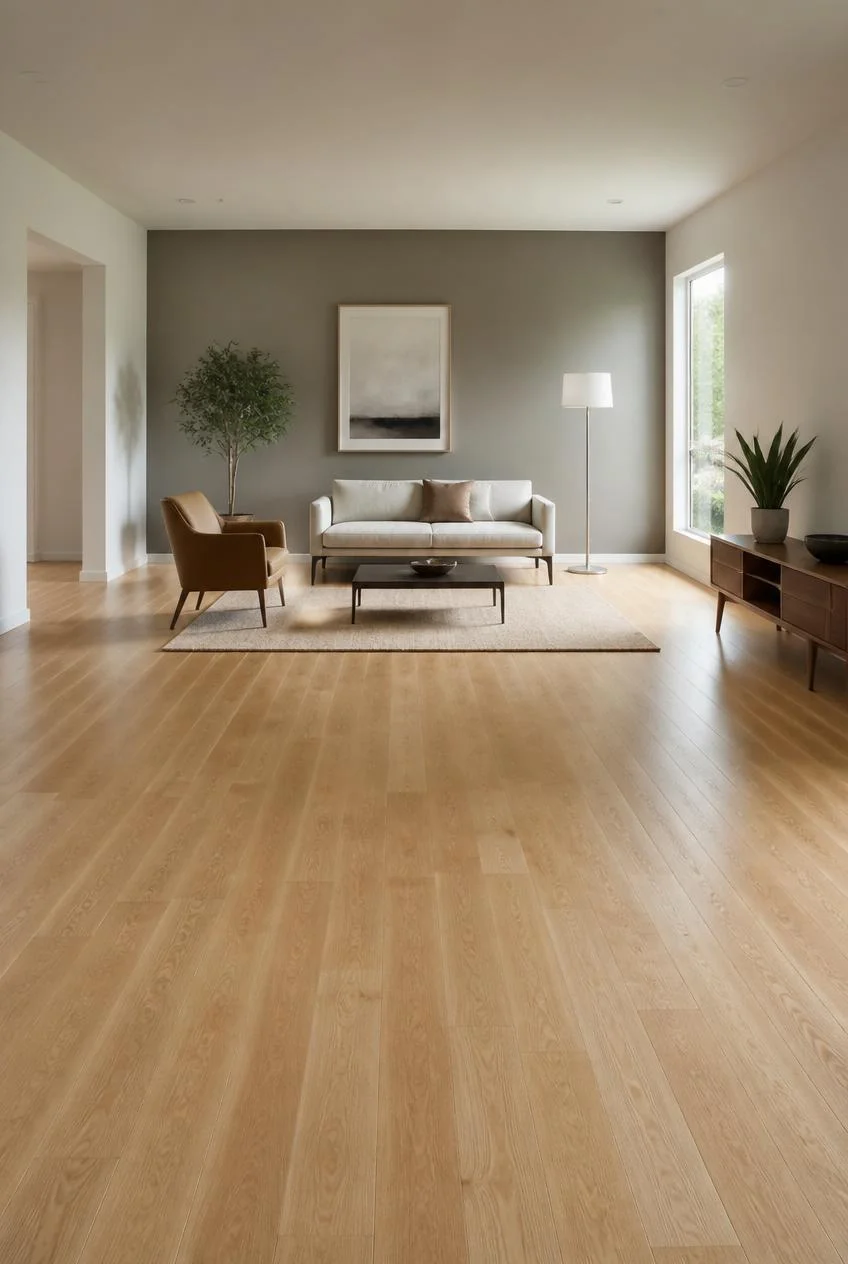
One of the most consistently underestimated principles in minimalist living room design is the value of visible floor space. The more floor the eye can see, the larger and calmer the room feels, since the uninterrupted horizontal plane of the floor reads as open space rather than occupied space. Every object placed on the floor, whether a basket, a stack of books, or a decorative object, reduces that sense of openness proportionally.
Choosing furniture with visible legs rather than base panels that reach the floor helps significantly, since the visible space beneath each piece adds to the overall sense of the room breathing from the ground up. A coffee table on slender tapered legs, a sofa raised on a frame rather than sitting flush to the floor, and side tables with open bases all contribute to this quality.
The Floor Rule
Beyond the rug, the floor should be completely clear of objects in every direction. No floor plants, no decorative baskets, no side table accessories placed at floor level. This single habit, kept consistently, makes a more significant difference to how a minimalist living room feels than almost any individual decorative decision.
Layered Lighting From Three Distinct Sources
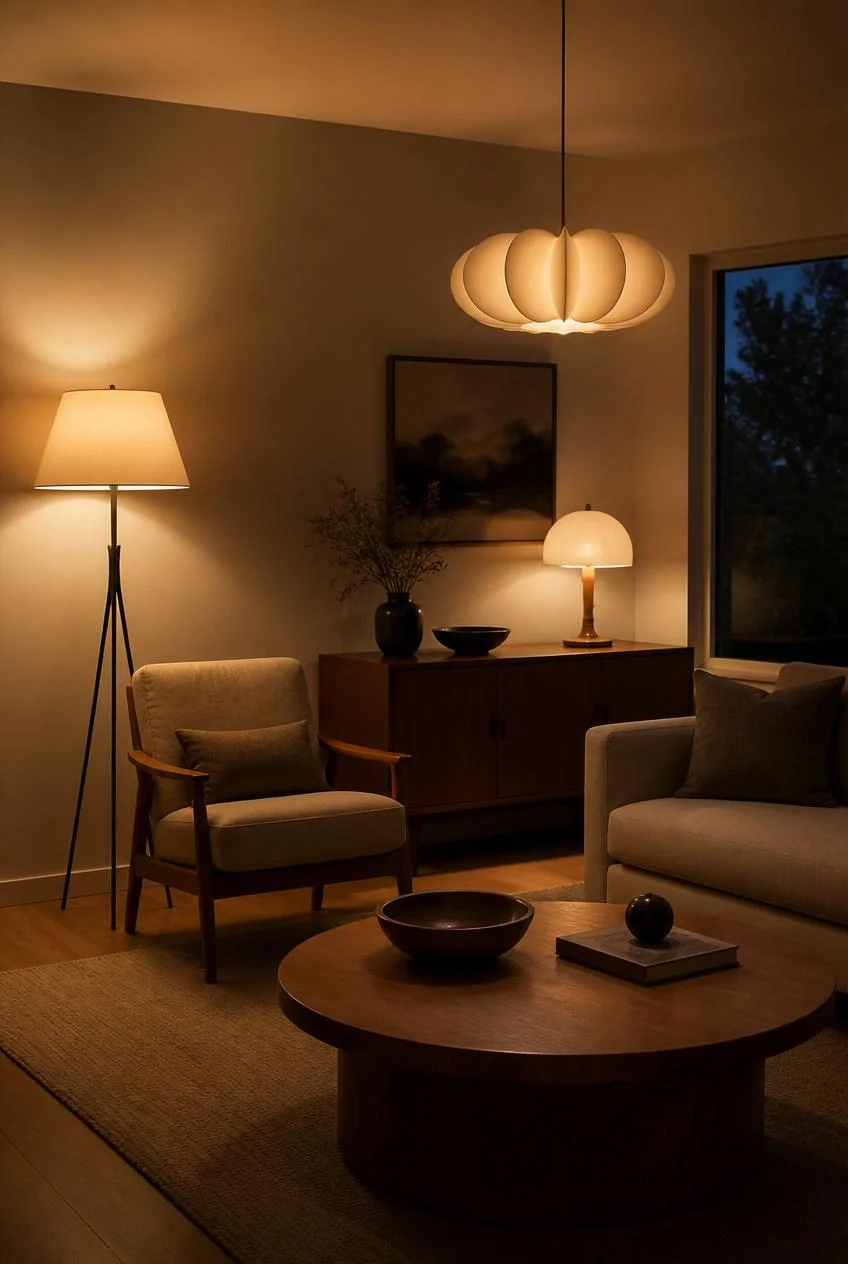
Layered lighting transforms a minimalist living room from a flat, uniformly lit space into a room that has depth, atmosphere, and genuine warmth at every hour. A single overhead light fixture, regardless of how well designed it is, eliminates shadow and flattens the room in a way that no amount of furniture or material choice can compensate for.
A sculptural floor lamp positioned near a reading chair, a warm table lamp on the sideboard, and a statement pendant above the seating area create three distinct pools and zones of light that give the room a layered quality after dark. All three should use warm bulbs in the 2700K to 3000K range to maintain the earthy, residential warmth of the neutral palette after daylight fades.
Dimmer Control
A dimmer switch on the main overhead circuit is arguably the most impactful single upgrade available in any living room, since it allows the light level to be reduced in the evening to a warmth and intimacy that completely changes the character of the space without altering a single piece of furniture or decor.
A Statement Pendant That Anchors the Room Vertically
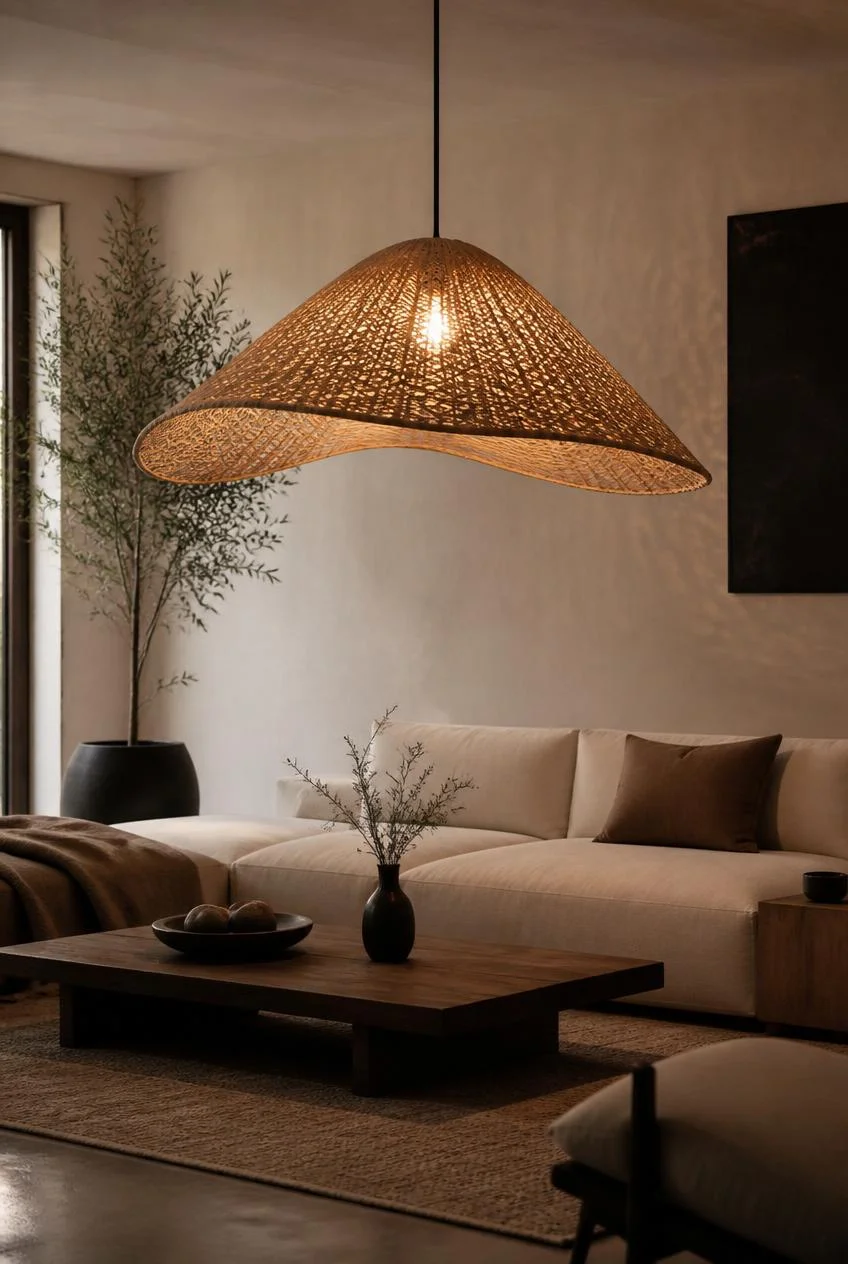
The pendant light in a minimalist living room carries a disproportionate amount of visual responsibility because it sits at a height where little else competes for attention. A sculptural pendant in rattan, aged brass, or a matte ceramic form above the main seating area gives the room a vertical focal point that grounds the arrangement below it without requiring any additional decoration on the surrounding surfaces.
The pendant should hang low enough to feel present above the seating, typically between 7 and 8 feet from the floor in a standard ceiling height, and its diameter should be proportionate to the seating group beneath it rather than scaled to the room as a whole.
Why Rattan Works
Rattan and woven pendant shades suit the warm minimalist aesthetic particularly well because the material is warm in tone, organic in texture, and casts a beautifully dappled light through its weave that adds atmosphere to the room after dark in a way that opaque shades cannot.
Linen Curtains Hung From Ceiling Height
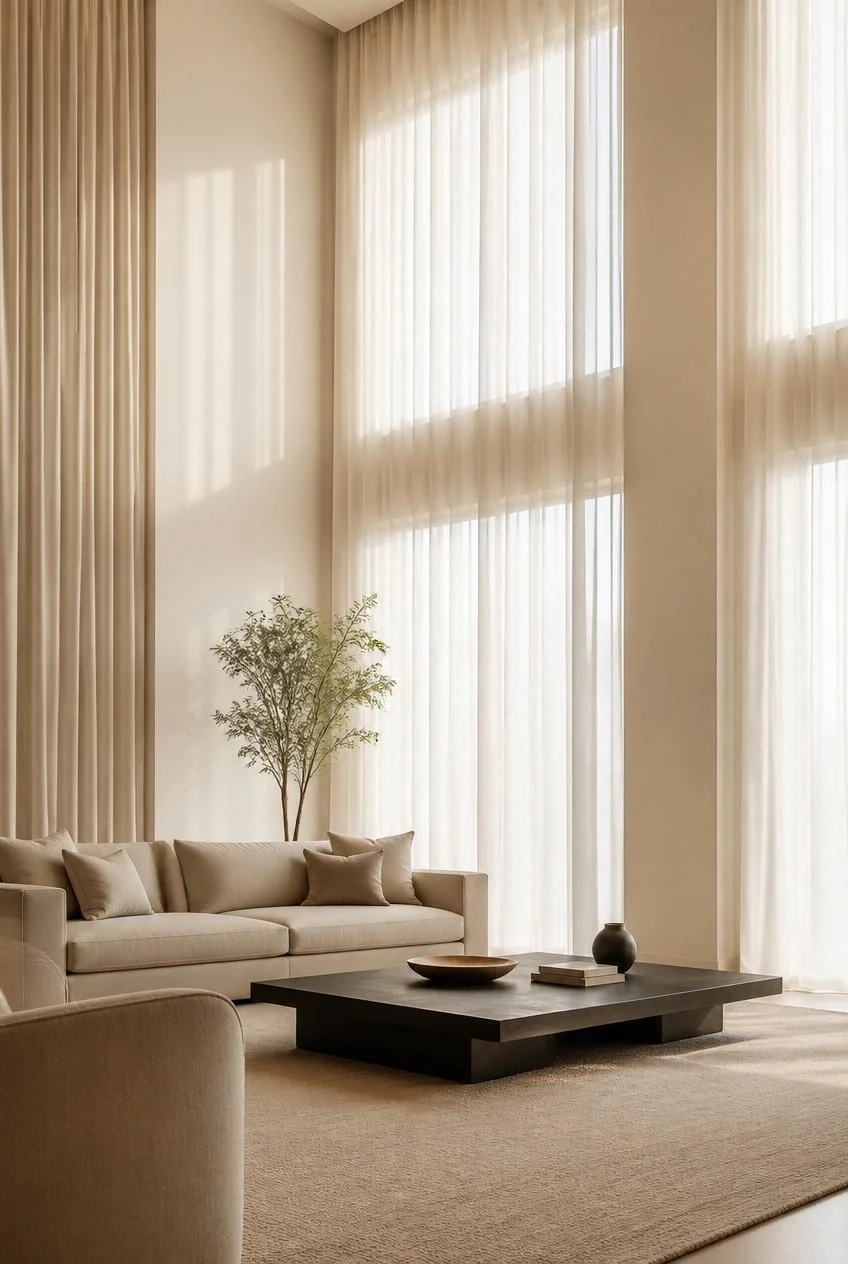
Linen curtains hung from ceiling height rather than from just above the window frame are one of the simplest and most transformative upgrades available in any minimalist living room. The additional height makes the ceiling feel taller, the room feel more generous, and the window feel more significant within the wall, all without any structural change.
Choosing a linen curtain tone that sits close to the wall color rather than contrasting with it reinforces the sense of the window as part of a unified wall surface rather than an interruption in it. This is the detail that makes curtains in a minimalist room feel architectural rather than decorative.
Practical Choice
A semi-sheer linen that filters natural light while offering daytime privacy suits most living rooms better than either a fully opaque blackout curtain or a fully transparent sheer, since it maintains the quality of diffused natural light that suits a warm neutral palette throughout the day.
A Curated Coffee Table With Only Two Objects
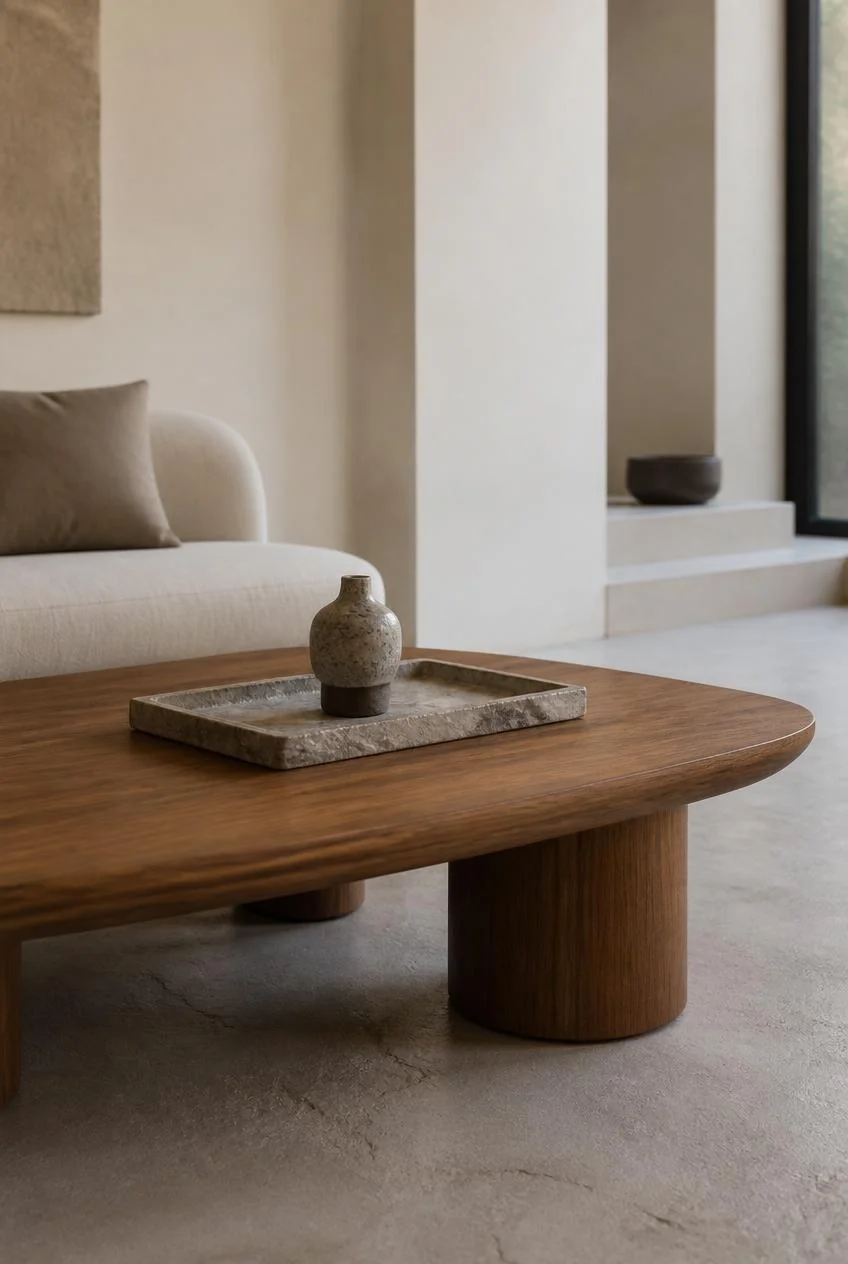
The coffee table in a minimalist living room is one of the surfaces most likely to accumulate unintentionally. A charging cable here, a book left open there, a glass that never quite made it back to the kitchen. Maintaining the discipline of a curated coffee table surface with only two intentional objects at any given time has a disproportionate effect on how the entire room reads.
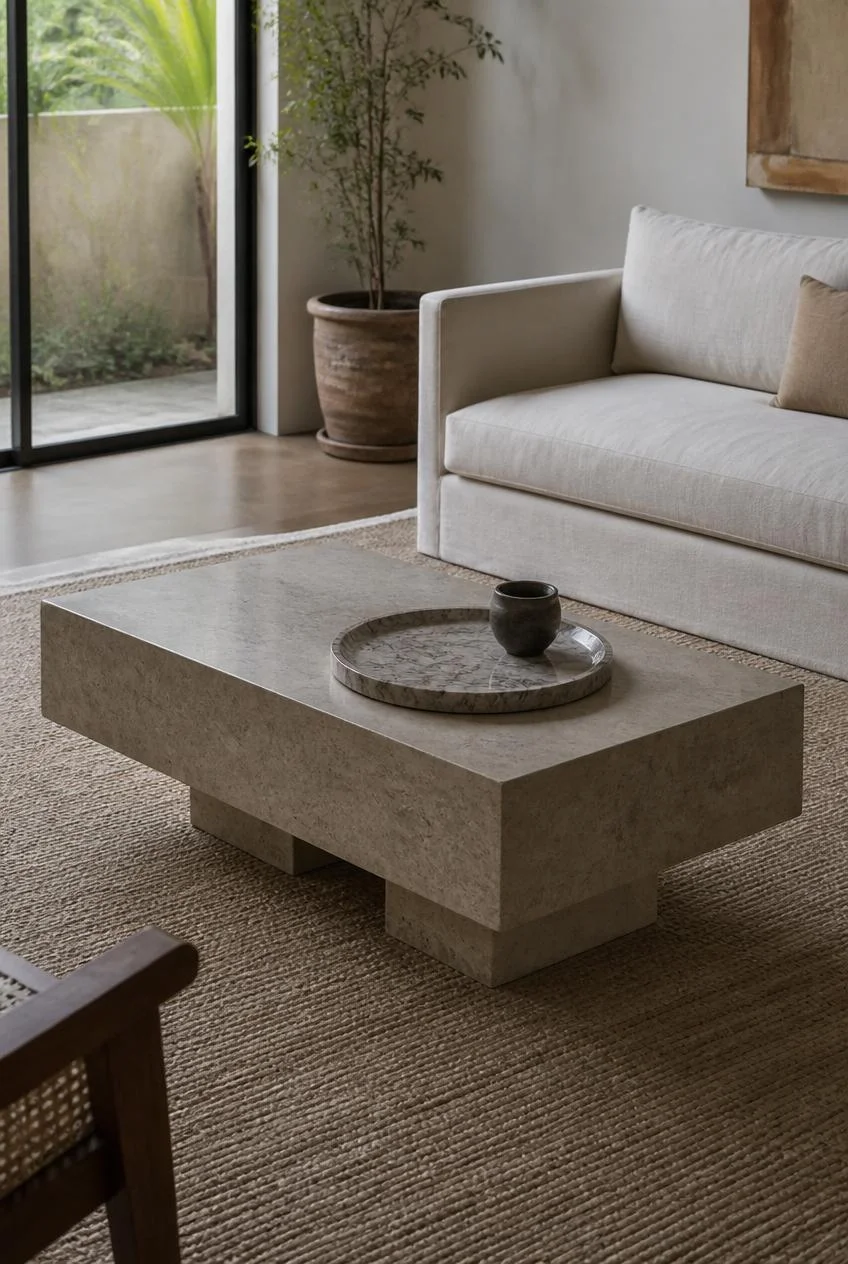
A stone or resin tray that contains and defines the display area, paired with a single handmade ceramic object or a small stack of two books, is a complete and resolved coffee table styling. The tray acts as a visual boundary that prevents the surface from becoming a general deposit point while adding a material and textural element that suits the warm minimalist palette.
Coffee Table Material
A coffee table in solid stone, concrete, or a warm wood tone with a simple geometric form suits a minimalist living room more naturally than a glass top, which reflects the room rather than reading as a material in its own right, or an overly ornate carved design that introduces unnecessary detail into the space.
Biophilic Elements Through a Single Large Plant
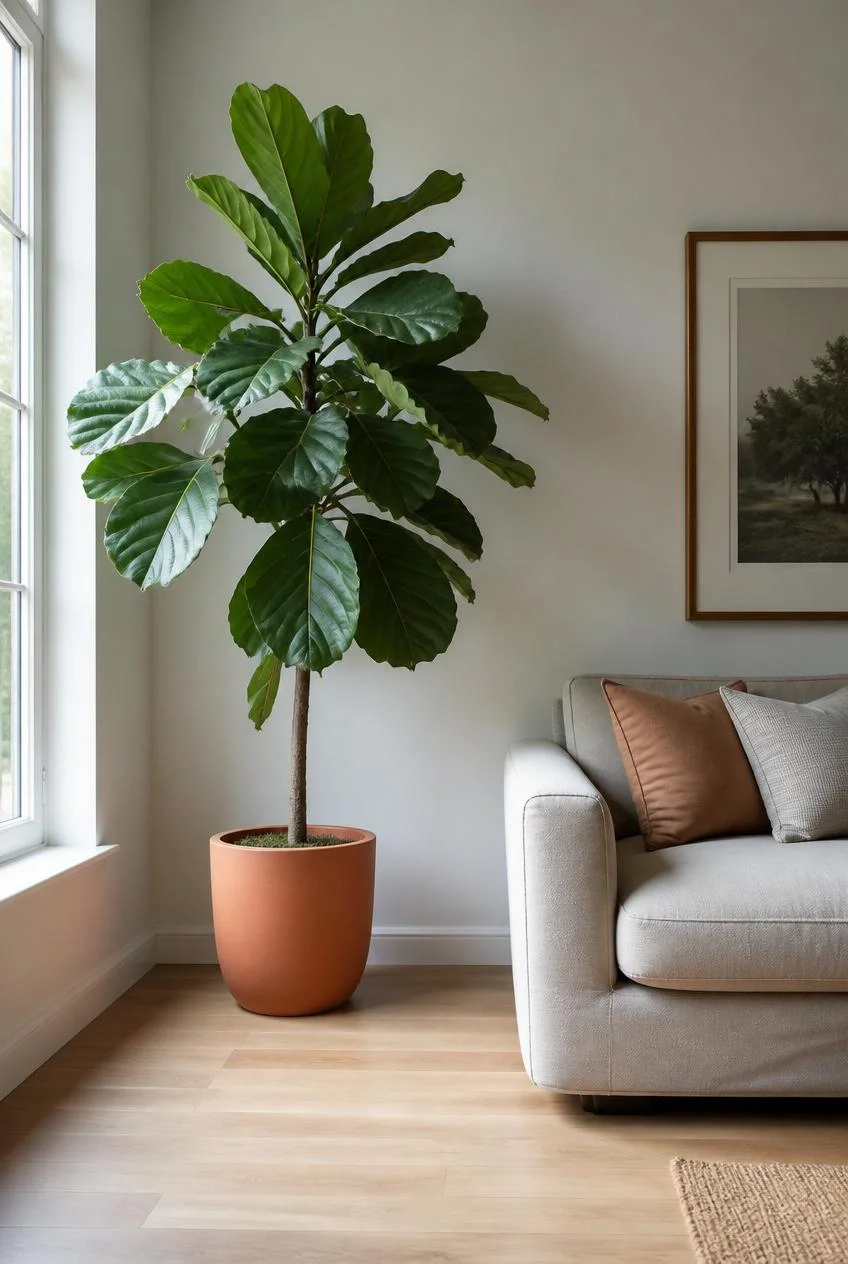
Biophilic design, the practice of connecting interior spaces to the natural world, finds its most accessible expression in a minimalist living room through a single well-chosen large plant. A tall fiddle leaf fig, a mature monstera, or a large olive tree in a simple matte ceramic pot positioned in a corner or beside the sofa gives the room a living, organic presence that no inanimate object can replicate.
In a room where every surface is deliberately calm and material-honest, a large plant introduces seasonal change and natural imperfection that prevents the space from feeling too controlled or too resolved. The slight unpredictability of plant growth, the way leaves shift with air movement and develop new shapes over time, gives the room a quality of aliveness that purely architectural decisions cannot manufacture.
Pot Selection
Choose a pot in a matte earth tone that reads as part of the room rather than a decorative accent in its own right. Terracotta, matte black, or an unglazed natural clay tone all suit a warm minimalist palette while allowing the plant itself to remain the primary visual element.
Japandi Principles Applied to Every Decision
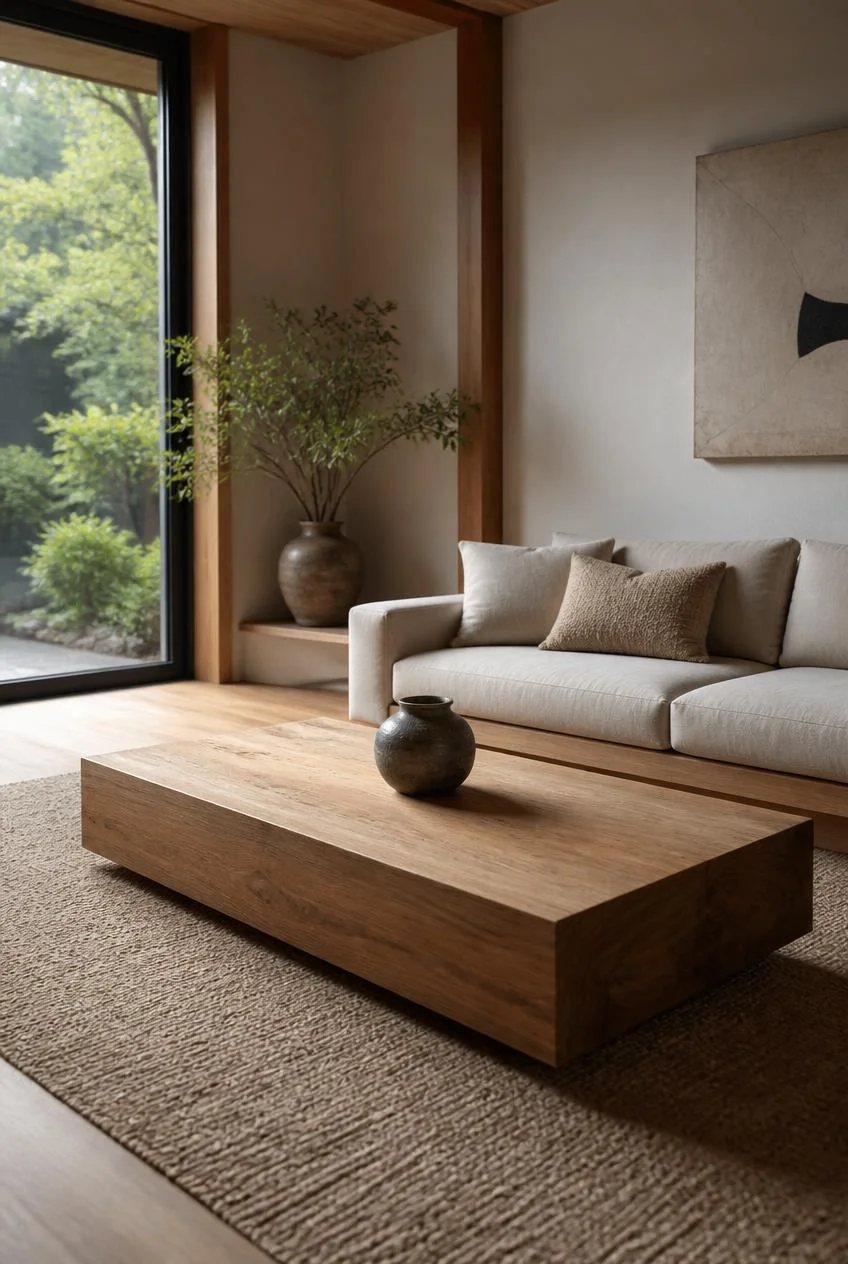
Japandi interior design, the combination of Japanese minimalist philosophy and Scandinavian functional warmth, provides one of the most coherent frameworks available for a minimalist living room that wants to feel genuinely complete rather than a work in progress. The core principle, that every object in the room should be both functional and beautiful, produces spaces where nothing sits without purpose and nothing useful is hidden purely for aesthetic reasons.
Applied to a living room, this means choosing a wooden coffee table that shows its grain honestly, a sofa whose form is as considered as its comfort, and lighting that serves the room’s mood rather than simply illuminating it. It means selecting a rug because its texture genuinely suits the space, not because it fills the floor. And it means being willing to leave surfaces empty not because the room is unfinished but because the space itself is part of the design.
Wabi-Sabi Within Japandi
The wabi-sabi philosophy, Japanese in origin and central to the Japandi aesthetic, treats imperfection and natural wear as qualities to be valued rather than corrected. A handmade ceramic with a slightly irregular rim, a wooden surface that shows its grain honestly, or a linen cushion that develops wrinkles in use all carry this quality naturally and prevent a minimalist room from feeling too polished or too perfect to live in.
Hidden Technology That Serves Without Showing
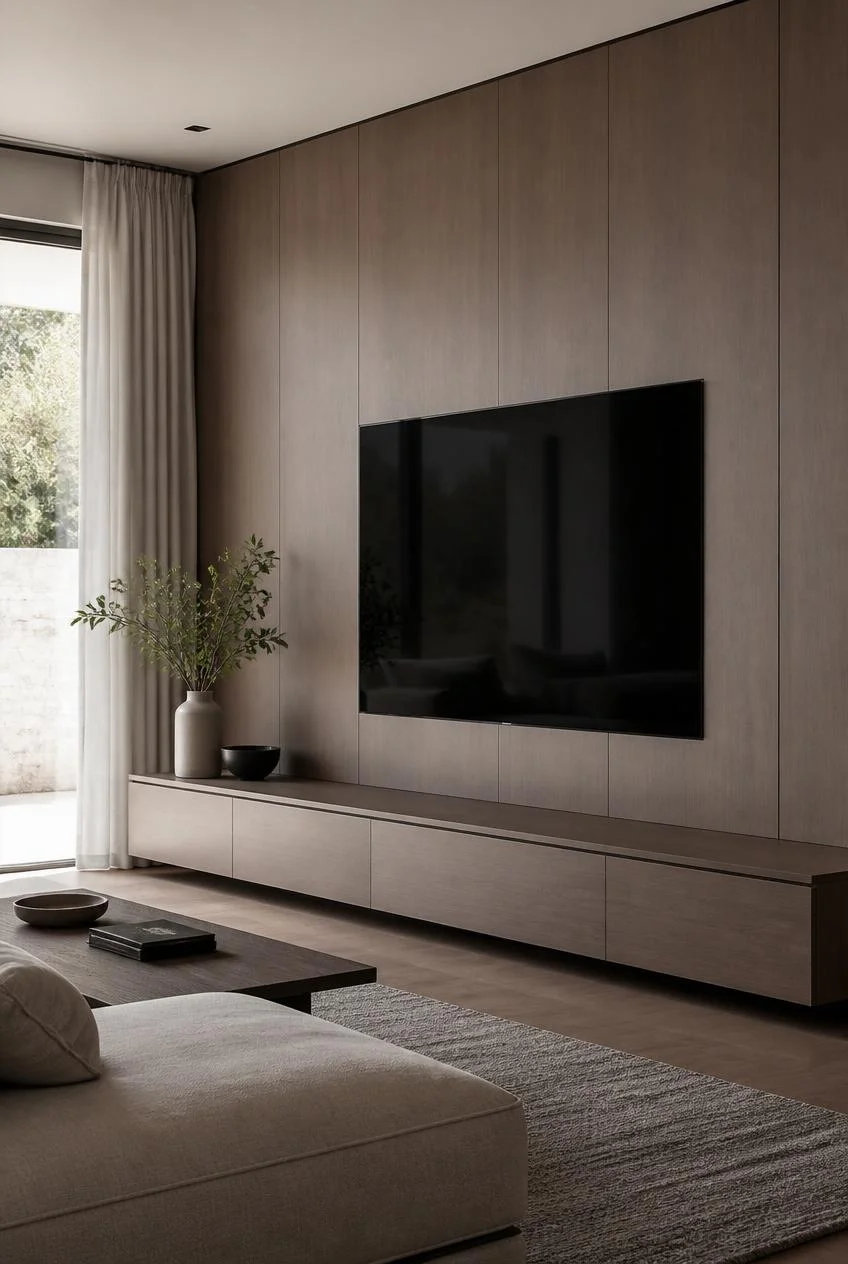
Technology in a minimalist living room earns its place by being useful, not visible. A television mounted flush to the wall with cables managed through the wall cavity rather than visible along the baseboard, a media console with closed doors that hides streaming devices and gaming systems, and smart home controls accessible through an app rather than displayed on multiple visible panels all keep the technology present in function while removing it from the visual composition.
A television that sits flush within a wall panel or recess, or one paired with a slim floating media shelf at the correct height, integrates into the room rather than dominating it. In an open plan living space, positioning the television on a wall that is not immediately visible from the entry point allows the room to read as a living space first and a media room second.
The Frame Option
A television with a gallery frame mode, which displays artwork when the screen is not in use, suits a minimalist living room well because it maintains the wall’s visual interest without requiring a separate piece of art nearby and removes the black rectangle problem that an off television creates in an otherwise carefully composed room.
A Textured Accent Wall Without Additional Decoration
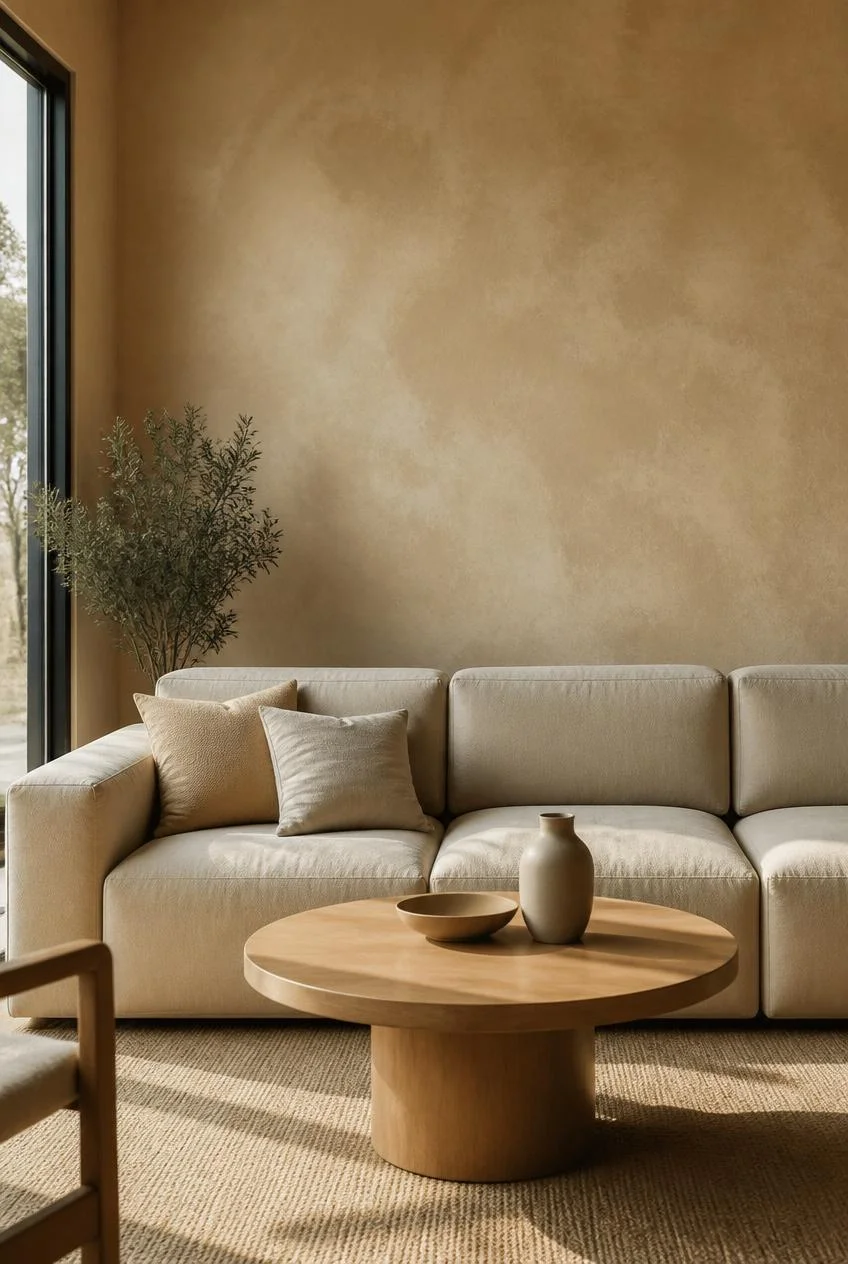
A textured wall finish, whether limewash plaster, a wood slat panel, fluted stone cladding, or a tadelakt application, gives one wall of a minimalist living room a depth and material richness that flat painted surfaces simply cannot replicate, without requiring any art, shelving, or additional objects to make it feel complete.
The texture itself provides all the visual interest the wall needs, which means the surrounding room can remain even more restrained than it would need to be with a plain painted wall that needs objects placed against it to feel resolved. A limewash finish in a warm sandy tone applied to the wall behind the sofa is particularly effective in this role.
Texture as a Neutral Element
Even a bold textured finish reads as neutral in the context of a warm minimalist color palette because the interest it provides is tactile and material rather than chromatic. This allows the room to absorb the textured wall without it acting as an accent in the way a brightly painted wall would.
A Monochromatic Bedroom Reading Corner
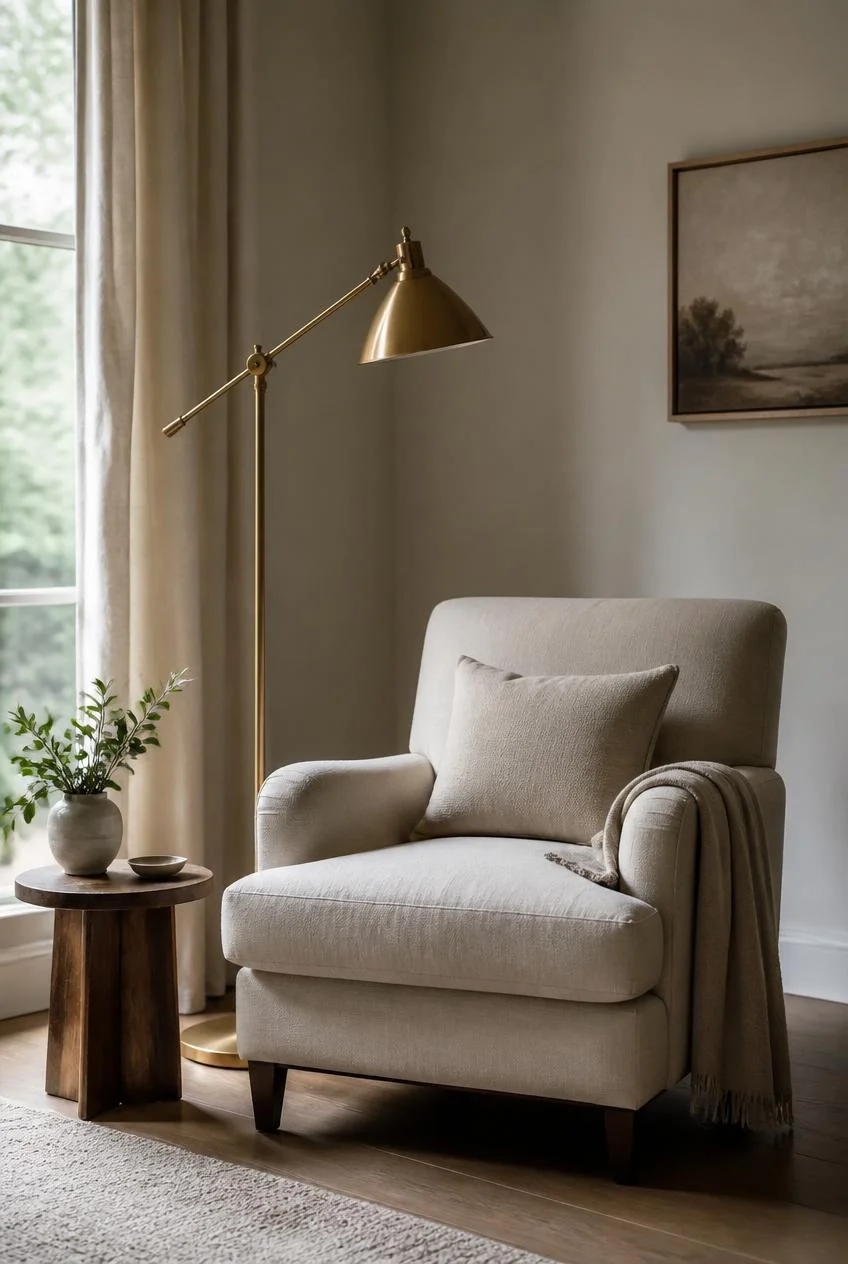
A reading corner within the minimalist living room, defined by a single armchair, a floor lamp, and a small side table, gives the space a secondary purpose and a secondary scale that prevents it from feeling like a room designed only for sitting facing a screen. The reading corner functions as a counterpoint to the main seating arrangement, offering a different mood and a different posture within the same room.
The chair, lamp, and table should be chosen to feel cohesive with the rest of the room rather than as a separate vignette, which means keeping materials and tones consistent with the overall palette. A linen or leather armchair in a tone close to the sofa, paired with a floor lamp in warm brass, creates a corner that feels like it belongs to the room rather than occupying it by accident.
Placement Principle
Position the reading corner near a window where natural daylight is available during the day, since the combination of good natural light and a comfortable chair is more inviting than either element alone and gives the corner a genuine reason to exist rather than simply looking styled.
Quality Materials Over Quantity of Objects
The principle that connects every other idea in this guide is one that operates more as a way of thinking than as a decorative technique. Quality over quantity in a minimalist living room means that every purchase decision is evaluated not on whether the object is beautiful in isolation but on whether it genuinely improves the room it enters. A beautiful object that competes with another beautiful object reduces the impact of both.
This means being selective about additions to the room and equally willing to remove objects that, despite being attractive individually, dilute the overall composition. The most resolved minimalist living rooms are almost always the result of removing things as much as adding them, and the willingness to do both with equal conviction is what separates a genuinely considered minimalist interior from one that is simply sparse.
The Editing Practice
Every few months, look at the living room as if seeing it for the first time and identify the one object that is working hardest against the overall calm of the space. Remove it. The room will almost always be better for the decision.
Handmade Objects That Add Character Without Clutter
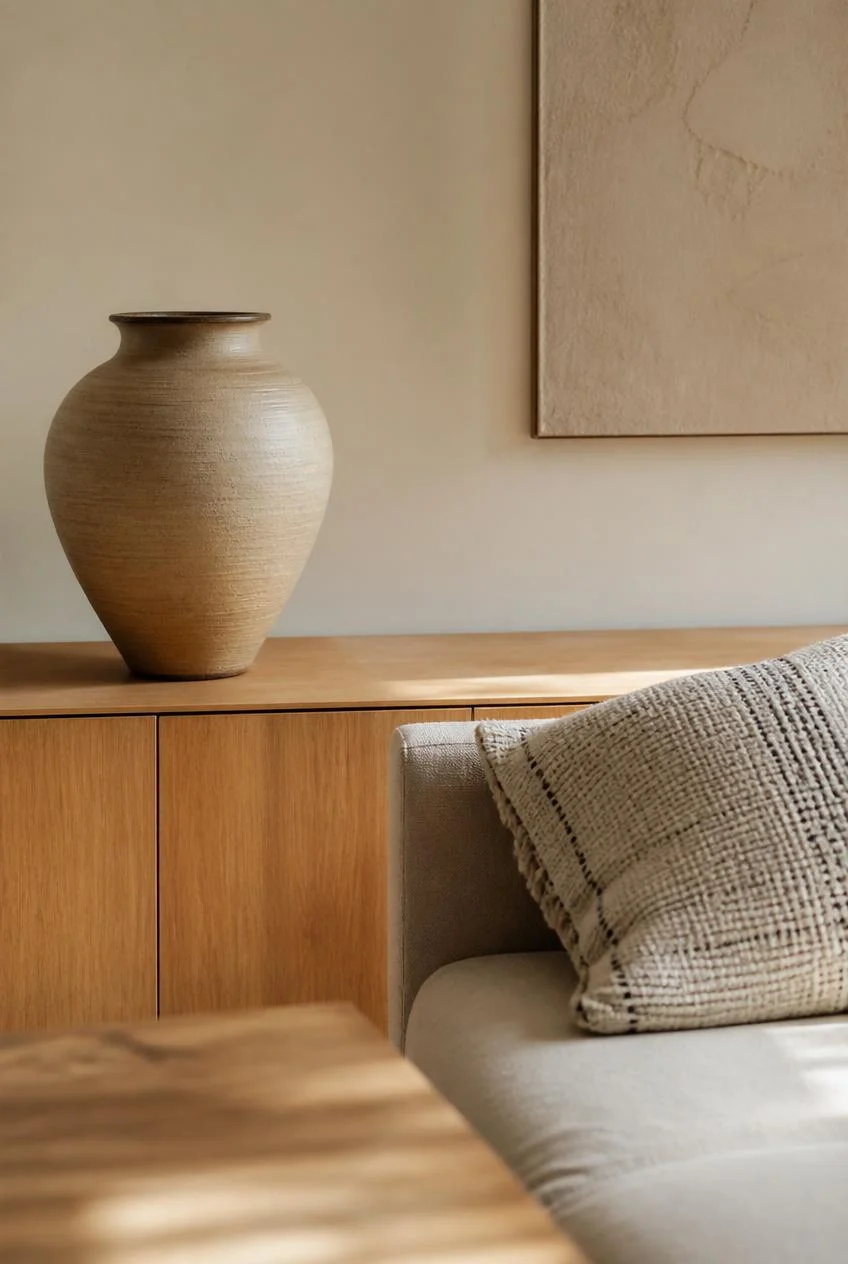
A minimalist living room needs character, and character in a restrained space comes not from the quantity of objects present but from the quality and specificity of the few that remain. Handmade objects, whether a wheel thrown ceramic vase, a hand-woven cushion, or a small wooden sculpture from an independent maker, carry a level of visual interest and tactile humanity that machine-made equivalents consistently fail to replicate.
In a room where surfaces are largely clear, each object that remains carries a responsibility that the same object would not carry in a busier space. A handmade object fulfills that responsibility because the irregularity of its form, the variation in its glaze or weave, and the evidence of the hand that made it provide genuine visual interest that rewards closer attention rather than disappearing after a single glance.
Sourcing Approach
Independent ceramicists, local craft markets, and handmade goods platforms all offer genuinely distinctive objects at a wide range of price points. Even a single piece chosen this way can shift the character of an entire room in a way that no mass-produced alternative manages.
Negative Space as the Room’s Finishing Detail
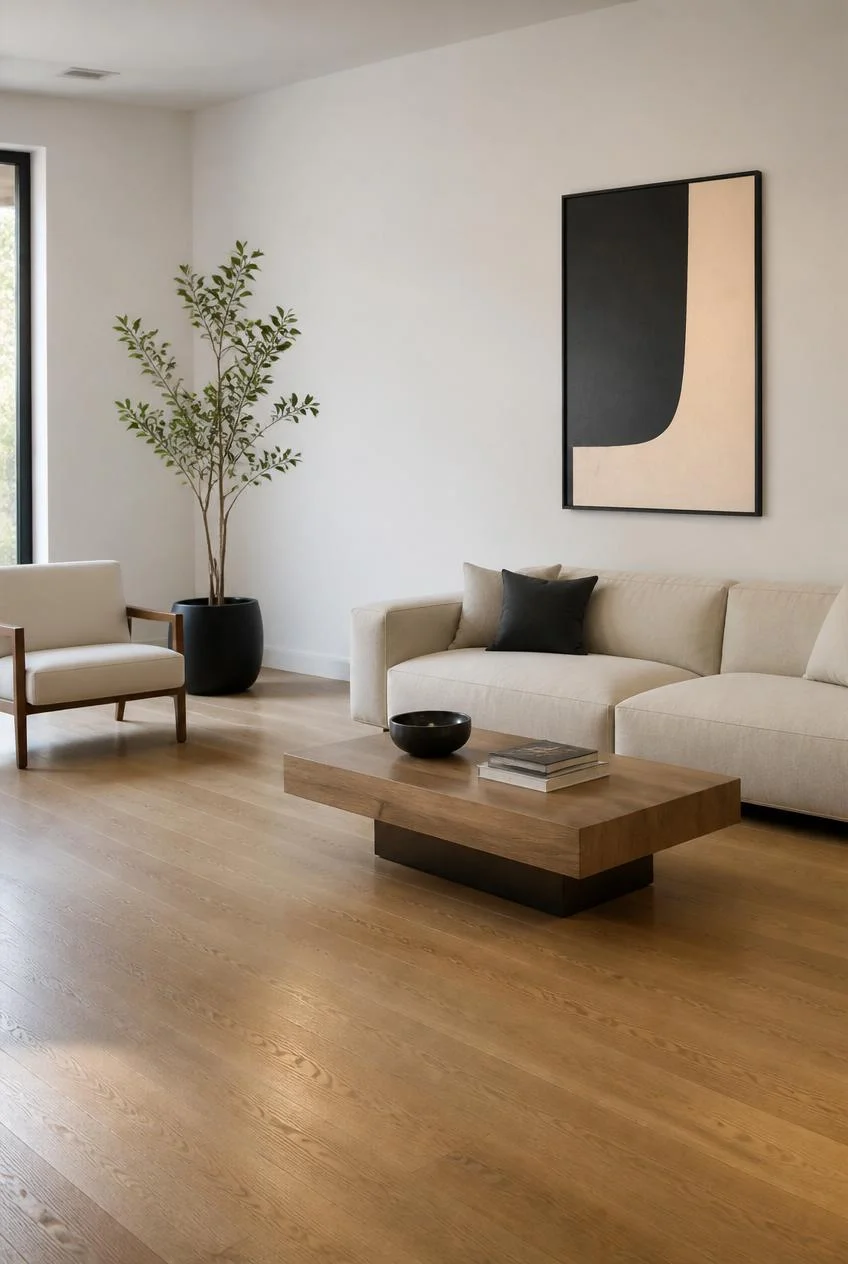
Every well-designed minimalist living room has one quality that distinguishes it immediately from a room that is simply sparse: the empty spaces feel chosen rather than unfinished. The bare wall beside the television, the clear surface of the coffee table, the open stretch of floor between the sofa and the window, none of these are oversights. They are the finishing detail that gives everything else in the room room to breathe.
Negative space in interior design functions the way white space functions in typography: it defines and clarifies what surrounds it. Without it, even beautiful individual elements compete rather than compose. A room that masters negative space gives the eye a path to travel, objects to appreciate fully, and surfaces to rest on between those objects. That combination is the specific quality that makes a minimalist living room feel genuinely restful to be inside rather than simply tidy.
The Final Edit
Before declaring a minimalist living room finished, walk through it with the specific intention of identifying what can be removed rather than what might be added. The answer is almost always something, and its removal almost always improves the room.
Why Restraint Creates the Most Beautiful Rooms
The minimalist living room ideas in this guide share a quality that has very little to do with a particular style or a specific material trend. They share intentionality: the discipline of choosing fewer things with greater care, the willingness to leave surfaces empty, and the confidence to let a single well chosen object do the work that ten careless ones could not manage together.
A timeless minimalist living room is not the result of buying particular products or following a particular aesthetic. It is the result of making design decisions consistently from the same set of principles: quality over quantity, texture over pattern, warmth over starkness, and restraint over accumulation. Practiced over time, those principles produce a room that gets better rather than more dated with each passing year, and that feels genuinely like home rather than like a version of someone else’s photograph.
FAQs
How do I prevent a minimalist living room from feeling cold or uninviting?
Introduce natural materials like solid wood, linen, jute, and wool in warm earthy tones, combine with warm bulb lighting in the 2700K range, and keep at least one large plant in the room. Texture, not color or quantity, is what adds warmth to a minimalist space.
What is the best sofa style for a minimalist living room?
A low-profile sofa with clean horizontal lines in a warm neutral linen or bouclé upholstery suits most minimalist living rooms. Avoid visible ornate stitching, deep tufting, or rolled arms that introduce unnecessary detail into the overall design.
How many decorative objects should a minimalist living room have?
A useful guideline is two or three objects per surface maximum, chosen for genuine material quality and beauty rather than as decoration alone. The coffee table should hold no more than two objects, and most walls should remain bare with the exception of one carefully chosen artwork.
Can a minimalist living room work for a family with children?
Yes. Durable material choices such as sealed wood, washable linen upholstery, and a flat weave rug combine the practical requirements of family living with the visual restraint of minimalism. Hidden storage in a sideboard or credenza is particularly valuable in this context.
Is warm minimalism different from traditional minimalism?
Yes. Warm minimalism introduces earthy neutral tones, natural materials, and layered textiles into the discipline of traditional minimalism, which relied more heavily on white, grey, and cool neutral palettes. The result is a room that shares the same structural restraint but feels considerably more inviting and residential.
You May Also Like This Post:
16 Minimalist Kitchen Ideas That Look Effortlessly Luxurious